

Getting around Milan: transport, tickets, times
Walking is our favorite way to move around Milan, but public transport here works very well. Tickets, times, options and other useful details.
Milan is a circular city. Somewhat chaotic if you’re driving around it for work, fairly convenient if you’re crossing it as a visitor. On foot it’s a pleasure, because the city changes character from one neighborhood to the next and from one hour to the next. But if you’d rather take something, because of the weather or just to rest a while, you’re usually spoiled for choice. Public transport in Milan works well, the metro serves practically every area worth reaching, and there are buses, historic trams and sharing services everywhere — bikes, mopeds, cars, scooters.
Isola is no exception. From our neighborhood you can easily reach three metro lines, trams pass through, a few bus routes serve it and you can rent just about anything. If you need to know how to move around Milan, this guide has what you’re looking for.
Tickets and how to pay
Milan’s public transport company, ATM, runs the whole city network: buses, trams and the metro. A single ticket is valid on any of them; here’s the link to ATM’s official page with the full details. Since January 1, 2026 ATM has stopped selling paper tickets, and an old ticket in your pocket is no longer valid. In their place there are three ways to buy:
- contactless payment: the easiest one. You tap your credit card or your phone at the gate, or on the bus, on the way in and on the way out, and the system works out the best fare for the journeys you’ve made that day. Nothing needs buying in advance;
- the RicaricaMi card, which is free, available from ticket machines in stations, at newsstands and at tobacconists, and loaded with whatever tickets you need: it holds up to thirty of the same type, plus a day or multi-day pass.
- the ATM app, with the ticket on your phone.
These are the city fares in force since January 2026 in zones Mi1-Mi3, which cover the whole city and Linate airport.
| Ticket | Price | Validity |
|---|---|---|
| Single journey | €2.20 | 90 minutes, across multiple trips and services |
| Day pass | €7.60 | 24 hours from first validation |
| Three-day pass | €15.50 | three consecutive days |
| Carnet of 10 | €19.50 | ten single journeys, transferable |
| Monthly pass | €39 | the calendar month |
To buy the special tickets, such as the three-day pass or the carnet, you need the ATM app. You can download it here.
One note: if you always pay with the same card, from the fourth journey onward the system applies the day-pass fare. Under-14s travel free across the whole network. The day pass starts to pay off from the fourth ride onward, and for a full weekend the three-day pass is worth it compared with two day passes.
Public transport
The official network map is the one posted in the stations. Download it before you go: underground your phone often has no signal, and a map saved on your phone works without coverage.
Download the network map (PDF, 2.8 MB)
Getting around by metro
Milan’s network has five lines. The red M1 cuts across the city from east to west, passing Duomo, Cordusio and Cadorna, and reaches Rho Fiera Milano. The green M2 connects Garibaldi to Cadorna, to the Navigli at Porta Genova and to Centrale station, with two branches to the east. The yellow M3 runs from north to south touching Centrale, Duomo and Porta Romana. The blue M4 starts at Linate airport and crosses the center at San Babila. The lilac M5 runs from Bignami to San Siro by way of Isola, Garibaldi, Zara and CityLife.
For anyone staying in the Isola neighborhood, the two most useful are the M5, which has a stop called Isola, and the M2, which from Garibaldi runs toward the center and the Navigli.
Trams and buses
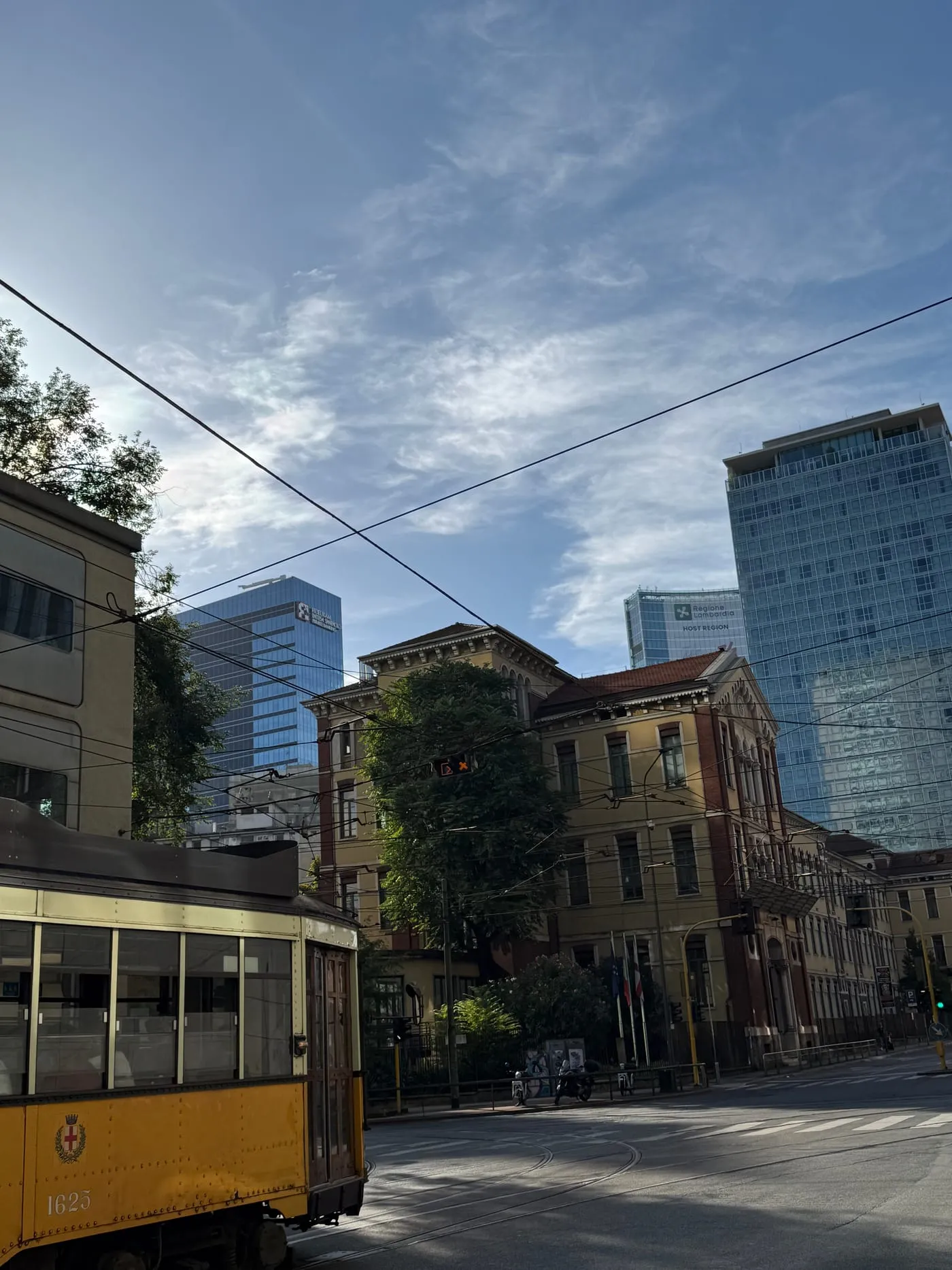
Trams and buses use the same ticket as the metro and cover the routes the underground network doesn’t reach. From Isola the most useful are the 33, which crosses the city diagonally, and the 60, which passes through piazzale Lagosta and piazza Segrino.
Surface transport has no gates: with contactless you tap your card on the validator on board, at the start of the ride.
After the last service
The last services leave the end stations between 12:10 and 12:30 a.m. depending on the line. The M1 closes between 12:10 and 12:20, the M3 around 12:23, the M4 around 12:26, the M2 at different times on its two branches, and the M5 is the first to stop, around midnight. The first services start again between 5:30 and 6 a.m.
There’s no automatic extension on Saturdays: later closing times do happen, but they’re tied to concerts, matches and events, and have to be checked case by case.
After closing there are four night bus lines — NM1, NM2, NM3 and NM4 — which follow the corresponding metro routes above ground, with less frequent service. There’s no complete replacement for the M5, so anyone coming back to Isola from the center late at night walks the last stretch from Garibaldi, which takes a few minutes, or takes a taxi. The ticket for the night buses is the same one.
Taxis
Getting around Milan by taxi isn’t a simple experience. Not for us, at least. Partly because finding a free cab on the street is rare: you’re better off calling or using an app. And partly because of the cost, which is decidedly not for everyone.
Fares differ depending on how the taxi is used:
- Single journey: one customer, or several people traveling together to the same place;
- Shared use: at least 3 people who aren’t traveling together and are only sharing the cab.
Initial fare
| Time band | Single journey | Shared use (min. 3 passengers) |
|---|---|---|
| Weekday (6:00–21:00) | €4.10 | €1.64 |
| Sunday/holiday (6:00–21:00) | €6.60 | €2.64 |
| Night (21:00–6:00) | €7.90 | €3.16 |
Source: City of Milan
Base rates
| Rate | Single journey | Shared use (min. 3 passengers) |
|---|---|---|
| Per kilometer | €1.32 | €0.53 |
| Per hour | €34.48 | €13.79 |
The meter’s first step up kicks in when the following amount is reached:
| Condition | Single journey | Shared use (min. 3 passengers) |
|---|---|---|
| Metered amount that triggers it | €17.35 | €6.94 |
| Per kilometer | €1.98 | €0.79 |
| Per hour | €51.72 | €20.69 |
The second step up applies when cruising speed exceeds 50 km/h for more than 60 seconds. The coefficient is cancelled automatically when the speed drops back below 50 km/h.
| Rate | Single journey | Shared use (min. 3 passengers) |
|---|---|---|
| Per kilometer | €2.25 | €0.90 |
The numbers to call:
- 024040 TaxiBlu
- 028585 Radio Taxi
- 026969 itTaxi
There are also apps that pool several drivers and make the search easier, such as appTaxi or Free Now.
Otherwise, you can try calling an Uber. In Italy the service has struggled to take off compared with other European countries, but in Milan it’s getting easier to find a ride through the app.
Bikes and scooters
The public bike-sharing scheme is BikeMi, run by ATM. A day pass costs €4.50, a weekly one €9 and an annual one €36. On top of the pass you pay for time: on the traditional yellow bikes the first 30 minutes are free and after that it’s 50 cents per half hour, while the red electric-assist bikes start at 25 cents.
In the Isola neighborhood there are several BikeMi docking stations, between Lagosta, Garibaldi station and the edge of Porta Nuova.
Alongside BikeMi there are the private free-floating bike, moped and scooter services, which you unlock with an app and leave in the designated bays. In the center and in pedestrian areas free parking isn’t allowed, and be careful, because the fine goes to whoever owns the account.
Driving in Milan
Using a car in Milan isn’t for the faint-hearted. For anyone visiting the city, having a car is more or less pointless unless your trip also includes excursions out of town — in which case there’s the train — or unless you’re carrying on to other stops in Italy.
The car-sharing services we’d currently recommend in Milan are Free2move and Enjoy, though bear in mind the latter has recently changed its rules and you have to pick up and drop off the car within certain areas of the city.
To manage the flow of traffic, Milan is divided into restricted zones. Area B is the environmental restricted zone and covers 72% of the municipal area, meaning almost the entire city, Isola included. There’s no charge: you either can or can’t enter depending on your vehicle’s emissions class. It’s in force Monday to Friday from 7:30 a.m. to 7:30 p.m., and in 2026 it excludes gasoline vehicles up to Euro 3 and diesels up to Euro 5.
Area C is the historic center inside the Bastioni ring, it costs €7.50 a day and applies during the same hours, Monday to Friday from 7:30 a.m. to 7:30 p.m. Isola isn’t included, so anyone staying in the neighborhood doesn’t pay Area C, unless they drive into the center.
A significant change in 2026 is the introduction of the night-time ZTL in Isola. It’s a neighborhood restricted traffic zone, in force every day from 7:30 p.m. to 6 a.m., monitored by nine electronic gates on piazza Spotorno, via Lario, via Traù, via Sassetti, via Rosellini, via de Castillia, via Ugo Bassi and via Porro Lambertenghi.
Residents and registered occupants with a permit may enter, along with anyone who has a garage or parking space inside the perimeter, motorcycles and mopeds, taxis and private-hire vehicles, emergency services and people working in the area’s businesses with a subsidized permit. Accommodation providers can register their guests’ license plates on the city’s portal.
Where to park
Inside the neighborhood you park in the blue-lined bays, paying at the meter or through a parking app, with an hourly rate and a maximum stay. Free spaces are scarce in the evening, because residents’ demand adds to that of people coming for dinner.
The alternatives are the private garages in the area and ATM’s park-and-ride lots, which sit at the end stations of the metro lines, charge a modest daily rate and let you leave the car for your whole stay. For anyone arriving by car and then moving around by metro, they’re almost always the cheapest solution.
From Isola to the rest of the city
| Destination | Route |
|---|---|
| Duomo | M5 > Garibaldi*, then M2 > Cadorna or M3 > Duomo |
| Brera | M5 or M2 > Garibaldi, then M2 > Lanza |
| Navigli | M5 > Garibaldi, then M2 > Porta Genova |
| CityLife | M5 > Tre Torri |
| San Siro | M5 > San Siro Stadio (end of the line) |
| Fondazione Prada | M5 > Garibaldi, then M3 > Lodi TIBB |
| Rho Fiera | M5 > Garibaldi, then red M1 > Rho Fiera |
| Assago Forum | M5 > Garibaldi, then M2 > Assago Milanofiori Forum |
How to reach the neighborhood from the airports and the stations is in getting to Isola, and choosing the area to sleep in is in where to stay in Milan. The places to head for once you’ve picked your line are in what to see in Milan and in what to see in Isola.
Map
Isola, Milano
The interactive map needs external scripts and stays off until there is a consent banner. In the meantime the area opens on OpenStreetMap.
Open the area on OpenStreetMap ↗Frequently asked questions
How much is a metro ticket in Milan?+
A city ticket costs €2.20 and is valid for 90 minutes with unlimited changes on the metro, trams and buses. A day pass costs €7.60, a three-day pass €15.50 and a carnet of ten rides €19.50. Under-14s travel free across the whole network.
Can you still buy a paper ticket?+
No. Since January 1, 2026 ATM paper tickets no longer exist. You tap your credit card or your phone at the gate, or you use a RicaricaMi card, which is free and available from ticket machines and newsstands.
How late does the metro run in Milan?+
The last services leave the end stations between 12:10 and 12:30 a.m. depending on the line. The M5 closes a little earlier, around midnight. After that there are the night bus lines NM1, NM2, NM3 and NM4, which follow the metro routes above ground.
Which line do you take from Isola to the Duomo?+
The lilac M5 to Garibaldi, then the green M2 toward Cadorna or the yellow M3 toward Duomo. Alternatively you can walk to Garibaldi or Gioia, both close to the neighborhood, and start off on the right line.
Can you drive into Isola in the evening?+
As of September 7, 2026, no, unless you fall into an authorized category. The neighborhood has a restricted traffic zone (ZTL) in force every day from 7:30 p.m. to 6 a.m., monitored by nine electronic gates.

Where to stay in Milan
Isola Urban Hub
Bright loft in the heart of Isola, walking distance from Porta Garibaldi and Bosco Verticale.
Carry on from here
Isola
Where Isola is, how it got its name, what it offers and why it's worth seeing or staying in. A guide to the once cut-off district that is now Milan's new center.
Open ↗Getting here
Getting to the neighborhood from Milan's airports and stations: which service to take, which one is worth it, and other things worth knowing.
Open ↗What to see
Isola is a neighborhood to live in, between art, markets, good food, tradition and modernity. Here's what you shouldn't miss.
Open ↗Where to eat
Isola has plenty of places to eat, from Italian classics to Asian food, pizza and aperitivo. At every turn the neighborhood has somewhere worth discovering. Here are the ones we recommend.
Open ↗