

Where to stay in Milan: the best neighborhoods
Milan is made up of many neighborhoods: some exclusive, some quiet, some lively and waiting to be found. Here are the safest and most interesting areas to sleep in.
Milan is compact: from the northern end of the metro to the southern one takes a little over thirty minutes, and almost everything people come to see sits within a small radius. The upshot is that choosing an area isn’t about travel times, which are similar almost everywhere, but about two other things: what the room costs, and what you find downstairs when you come back in the evening.
This page is written from Isola, which is one of the areas worth considering and where we happen to own an apartment. We’re saying so here, at the top, and we come back to it at the end.
The best areas to stay
| Area | Metro | Who it suits |
|---|---|---|
| Duomo and the historic center | M1, M3 | first time in the city, one or two nights |
| Brera and Moscova | M2 Lanza, M3 Montenapoleone | people who want to walk and take nothing |
| Isola and Porta Garibaldi | M5 Isola, M2 and M5 Garibaldi | neighborhood life at night, trains and Malpensa |
| Navigli and Porta Genova | M2 Porta Genova | long evenings, people who don’t have to get up early |
| Porta Venezia and Porta Romana | M1 Porta Venezia, M3 Porta Romana | the best balance of price and convenience |
| Milano Centrale | M2, M3 | arriving and leaving by train, short stops |
| CityLife and Fiera | M5 Tre Torri, M1 Lotto | trade fairs at Rho, trips by car |
| Città Studi and Lambrate | M2 Piola, M2 Lambrate | long stays, tight budgets |
The historic center
Inside the ring, between the Duomo, Cordusio and San Babila, you sleep in the area that makes it worth seeing Milan in the first place, but also the most expensive and most crowded part of the city. It’s the only area where the museum, the cathedral and the shopping streets are all reachable without taking anything, though in the view of people who’ve lived in the city, stopping at the classic center would be like seeing half of Milan. The most obvious half, at that.
The price of sleeping — and eating, and getting around — is the highest in the city in every category. There’s also something the guides rarely mention: central Milan empties out after nine in the evening. The offices close, the shops too, and to have dinner outside the tourist circuit you have to travel anyway. If you want a city that’s alive at night within five hundred meters, the center isn’t where you’ll find it.
On the driving side, the historic center falls inside Area C, the congestion charge for the Bastioni ring. If you arrive by car and your hotel has no partner garage, parking becomes a daily line on the budget. Unless you specifically want somewhere ultra-exclusive, with a Duomo view or luxury service, it’s better avoided.
Brera and Moscova
Brera is the compromise that works for most short trips: you walk to the Duomo in a quarter of an hour, the Pinacoteca is right there, and in the evening the neighborhood stays open because people actually live there and not just work there. Moscova and Garibaldi, just to the north, keep the same advantage and cost a little less.
It’s an area where what’s on offer leans toward four stars and high-end holiday apartments, with few three-star hotels and almost no hostels. If you’re trying to spend little, there isn’t much to choose from here either.
Isola and Porta Garibaldi
Isola sits north of the center, beyond the Porta Garibaldi tracks, and it has two things the center doesn’t: a neighborhood life that carries on past office hours, and a station with trains to Malpensa right inside the neighborhood. The Malpensa Express reaches Porta Garibaldi in 41 minutes for €15, and that changes the arithmetic for anyone landing there.
The metro serves the area with two lines: the lilac M5, which has a stop called Isola, and the green M2 at Garibaldi, which runs to the center and to the Navigli. For the Duomo you change once.
Prices sit below the center’s and above the eastern ring’s, and the reason is Porta Nuova: the skyscrapers, the offices and the Biblioteca degli Alberi have lifted the area over the last ten years, and short-term rents have risen with it. On restaurants, the bill stays lower than in the center.
Navigli and Porta Genova
On the Navigli you sleep where the city goes out at night. It’s the area with the highest concentration of bars in Milan, you get there on the M2 at Porta Genova, and for anyone traveling to enjoy themselves it’s the obvious choice.
The two drawbacks are well known and worth stating. The first is noise: on weekends, along both banks of the Naviglio Grande and around the Darsena, the street stays packed until late, and a room facing the canal is not a room you sleep in. The second is that the area is less well served than it looks: the M2 covers Porta Genova, but much of the Navigli has to be reached on foot or by tram, and with luggage you feel the difference.
Porta Venezia and Porta Romana
This is the ring where the balance of price and convenience works best. Porta Venezia is on the red M1, two stops from the Duomo; Porta Romana is on the yellow M3, three stops away. Both are residential neighborhoods with shops, markets and local restaurants. You pay less than in the center and you get to the center faster than from the Navigli.
Porta Romana also has the Fondazione Prada and the Olympic Village built for the 2026 Winter Games, which brought new services to the area and, along with them, a rise in prices worth keeping an eye on.
Milano Centrale
Around Centrale station there’s the highest concentration of rooms in the city, and it’s the area where you find something when there’s nothing anywhere else: plenty of three-star hotels, chains, and prices that fall faster than elsewhere when demand drops. The trade-off is that it’s a place people pass through rather than a neighborhood, and some streets east of the station aren’t pleasant at night.
CityLife
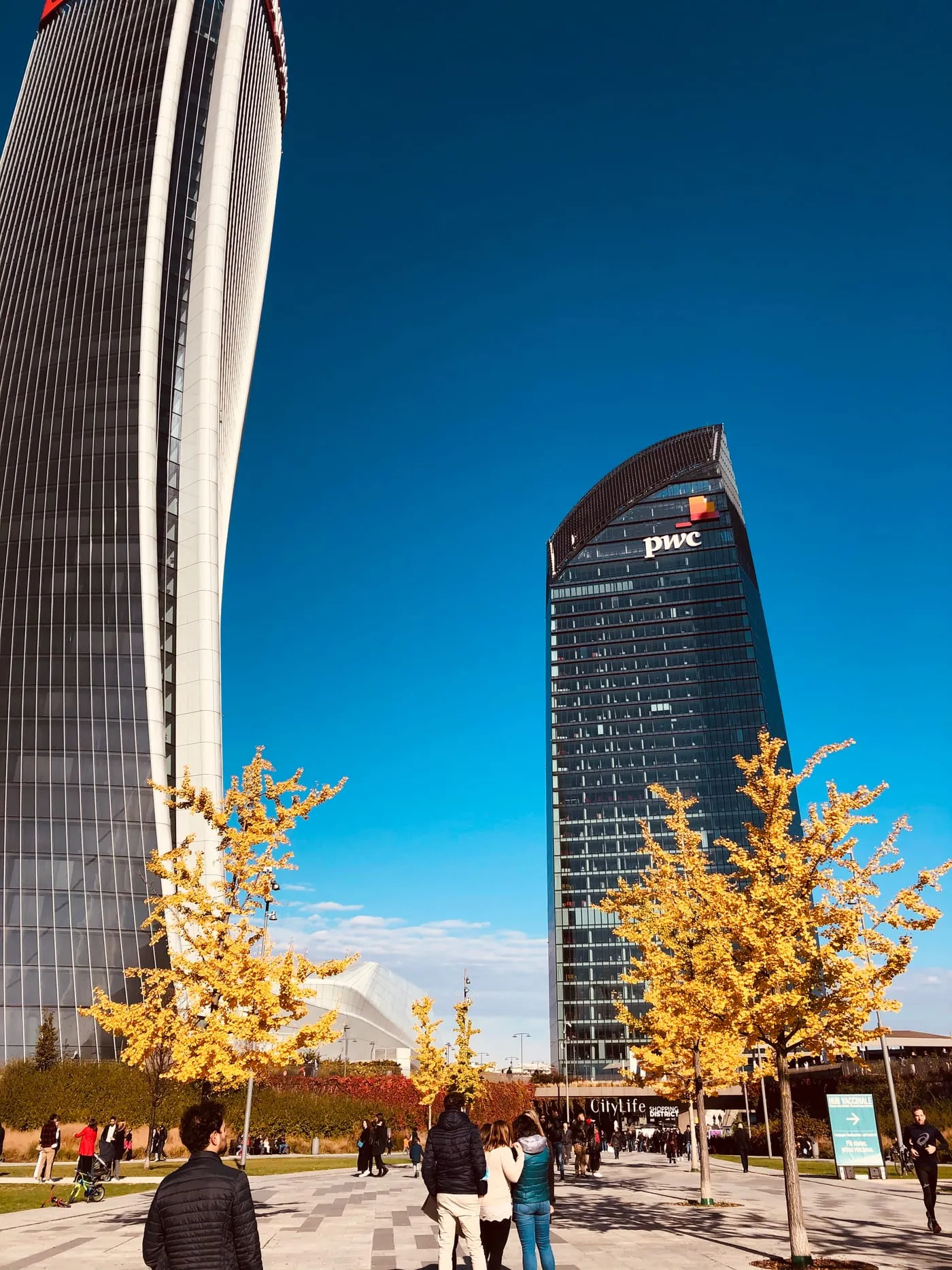
CityLife and the Fiera area are on the other side, to the west. It makes sense for anyone coming for a trade fair at Rho, because the M1 goes to the exhibition center without changes, and for anyone arriving by car, because outside Area C parking is less of a problem. For pure sightseeing it’s far from everything else.
Areas to avoid
Rho and the towns around the exhibition center cost less and seem like a good idea until you count the travel: that’s twenty minutes of metro just to get back into the city, twice a day, and in the evening there’s nothing around.
The same goes for neighborhoods off the metro network. Milan has good surface transport, but trams and buses thin out at night, and a room that costs forty euros less gets paid for in taxis by the second trip home. The practical rule is simple: pick a metro stop first, then look within five hundred meters of it.
What it costs
The average rate for a room in Milan in 2025 was €208.22 a night, up 3.8% on the year before. It’s the second-highest figure in Italy after Venice, at €250.92, and it comes from the Italian Hotel Monitor by Trademark Italia, which tracks 39 cities.
It’s an average, and like all tourism averages it has to be read knowing what’s inside it: luxury pulls it up considerably. On the same sample, the national average rate was €73.55 in three-star hotels, €159.49 in four-star hotels and €627 in the luxury segment. The number you need for a budget is the one for your own category, not the one for the city.
The tourist tax
Milan has raised it three times in three years, and since January 1, 2026 these are the rates, per person per night, set by the city council in resolution 1418 of November 13, 2025.
| Type of accommodation | € per person per night |
|---|---|
| Hostels and open-air accommodation | 3.00 |
| 1-star hotels | 4.00 |
| 2-star hotels | 5.00 |
| Holiday homes | 7.00 |
| 3-star hotels | 7.40 |
| B&Bs and short-term rentals | 9.50 |
| 4- and 5-star hotels | 10.00 |
It’s charged for a maximum of 14 consecutive nights, after which nothing more is due. Exemptions cover under-18s, Milan residents, hospital patients with one companion, and police officers on duty.
Two quick sums to see what it weighs. A couple staying four nights in a three-star hotel adds €59.20 to the bill. The same couple in a short-term rental adds €76. On a €400 stay that’s nearly a fifth.
The busiest weeks
Milan has no real low season, but it does have weeks when rooms disappear and prices climb sharply. Those are the trade fairs and the fashion weeks, and they fall at more or less the same times every year.
The heaviest is the Salone del Mobile, which in 2027 runs from April 13 to 18 at the Rho fairgrounds, with the Fuorisalone filling the center, Brera, Isola and Tortona at the same time. In those days any room at all costs double or triple the usual, and booking three months ahead already leaves you with slim pickings. The fashion weeks, in February and September, have the same effect on a smaller scale.
If you can choose your dates, check the trade fair calendar before buying the flight. If you can’t, book well ahead and budget for one category lower.
Hotel, hostel or apartment
A hotel makes sense for single nights and short stays, because there’s no fixed cost to get in: you pay for the night and that’s it. Under two nights it’s almost always the cheapest option, cleaning fee aside.
A short-term rental apartment starts to make sense from the third night onward and with more than two people, because the cleaning fee spreads out and the kitchen takes at least one breakfast and one dinner off the bill. Look at the number of real beds rather than the stated guest capacity, and look for the CIN in the listing: since 2025 every Italian accommodation business has been required to display it, and a listing without one is operating irregularly.
A hostel remains the cheapest option outright, with the lowest tourist tax in the city, and in Milan they’re concentrated around Centrale, Porta Venezia and the Navigli.
Our loft
Our apartment is in Isola, it’s called Isola Urban Hub, it sleeps up to four people across two levels and it’s booked through Airbnb.
It suits people staying more than two nights, traveling as two couples or with children, who want an area with restaurants downstairs in the evening. It doesn’t suit anyone staying a single night, anyone who wants the Duomo on foot, or anyone who needs a 24-hour reception desk.
What’s inside, what it costs and how to book are on the loft page. From here on, the rest of the city: getting around and what to see in Milan.
Frequently asked questions
What's the best area to stay in Milan?+
There isn't a single one. The historic center and Brera have real character, but they're also very crowded and expensive. To spend less, look at the ring just outside: Isola, Porta Romana, Porta Venezia, Città Studi. The Duomo is always less than a quarter of an hour away by metro, or a pleasant walk.
How much does a night in a Milan hotel cost?+
The city's average rate in 2025 was €208.22 a night according to the Italian Hotel Monitor by Trademark Italia, second in Italy after Venice. That average includes luxury hotels. In an apartment you'll spend somewhat less.
How much is the tourist tax in Milan?+
Since January 1, 2026 it runs from €3 per person per night in hostels to €10 in four- and five-star hotels, with €9.50 in B&Bs and short-term rentals. It's charged for a maximum of 14 consecutive nights, under-18s are exempt, and the amount isn't included in the price you see online.
Is it worth staying outside Milan to save money?+
Almost never. What you save on the room goes back out on train tickets and time, and in the evening you return to an area where nothing is open and which may not feel especially safe. Better to be slightly outside the center but in a dependable neighborhood.
Is it better to stay in Isola than in the center?+
If you care about having bars and restaurants downstairs in the evening, yes: Isola has a neighborhood life that the historic center doesn't have after nine, it's well connected to the center, it's green and it's easy to walk. The one drawback can be night-time noise, especially on weekends, though the new traffic restrictions may reduce it. If you're staying a single night and you want the Duomo on foot, the center is more convenient.

Where to stay in Milan
Isola Urban Hub
Bright loft in the heart of Isola, walking distance from Porta Garibaldi and Bosco Verticale.
Carry on from here
Isola
Where Isola is, how it got its name, what it offers and why it's worth seeing or staying in. A guide to the once cut-off district that is now Milan's new center.
Open ↗Getting here
Getting to the neighborhood from Milan's airports and stations: which service to take, which one is worth it, and other things worth knowing.
Open ↗What to see
Isola is a neighborhood to live in, between art, markets, good food, tradition and modernity. Here's what you shouldn't miss.
Open ↗Where to eat
Isola has plenty of places to eat, from Italian classics to Asian food, pizza and aperitivo. At every turn the neighborhood has somewhere worth discovering. Here are the ones we recommend.
Open ↗